Of the 21 countries that practice the death penalty, Iran carried out
the second-greatest number of executions in 2012 (after China),
according to a report released by Amnesty International on Wednesday
(10.04.2013). Beyond the 314 official executions in the Islamic
Republic, the group cited reports of at least 230 additional secret
executions.
One of the deadly offenses is "enmity against God," a vague charge the
Iranian state has used in political attacks against government opponents
and minorities. About 40 to 50 percent of the Iranian population
consists of ethnic or religious minorities, including Azerbaijanis,
Kurds and Iranian Arabs, also known as Ahwazi Arabs. The roots of these
minorities go back hundreds of years, and in the past they've have been
tolerated and granted rights.
But minorities are increasingly seen as a threat to consolidation of a
homogeneous Persian, Shiite nation. Under the hard-line administration
of President Mahmoud Ahmadinejad, Iran has increased arrests and
executions of minorities - including against Ahwazi Arabs. After a trial
widely viewed as unfair in June of 2012, four Ahwazi Arabs were
executed, while the death sentence for five others was upheld this past
January.
Although the five Ahwazi Arabs were found guilty of links to terrorist
groups, Amnesty describes them as peaceful activists. Two who admitted
to committing crimes on national television have since retracted, saying
they were tortured to make them confess. In late March, the five
started a hunger strike to protest their unfair sentences and ill
treatment in prison.
Kamil Alboshoka, an Ahwazi who fled Iran in 2006, is cousin to two and
friend to the other three of the five Ahwazi Arabs on death row. He
shared his personal story with DW.
Cultural dialogue
Alboshoka and the five men - Mohammad Ali Amouri, Sayed Jaber Alboshoka,
Sayed Mokhtar Alboshoka, Hashem Sha'bani Amouri and Hadi Rashidi - in
2002 established the cultural group Al Hawir, which means "dialogue," to
help preserve the Ahwazi Arab language.
"It was helpful because we motivated people to study," Alboshoka told DW
in an interview. Because of the group's work, Alboshoka said, more than
200 women initiated university studies from 2002 to 2005.
Al Hawir also sponsored social events, including parties for thousands
of people, featuring Arabic music, poetry and theater. Although the
group operated with government permission, Alboshoka said they "were
under pressure by intelligence services."
Every April, Ahwazi groups mark the annexation of their homeland by
Iranian forces, which occurred in 1925. In 2005, changes to the name of
the region, along with plans to displace Arabs and settle Persians
there, sparked Ahwazi demonstrations in the southwestern Iranian
province of Khuzestan.
"People got sad and angry, and protested," Alboshoka said. In April
2005, demonstrators seeking rights and autonomy clashed with Iranian
security forces, and many were killed as the uprising was put down.
"Actually we didn't think they would use live ammunition against us," Alboshoka commented.
A spate of deadly bombings, for which Ahwazi separatist groups took
credit, heightened tensions from mid-2005 to mid-2006. Separatists in
the oil-rich region had been encouraged by Arab countries that sought to
destabilize Iran. In June 2005, after Ahmadinejad came to power, Al
Hawir was banned. Alboshoka was among the Ahwazi activists detained that
year.
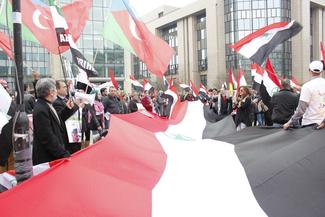
Mass arrests of minorities are among the repressive tactics the Ahmadinejad administration has used
'Once a day torture, twice a day interrogation'
Alboshoka was arrested at the bazaar in his hometown, a small city south
of Ahvaz. He said he was handcuffed and blindfolded, and hours later
arrived in what he believed to be the city of Ahvaz. There, he said, he
was tortured for the first time.
"Once a day torture, twice a day questioning," is how Alboshoka
described the four weeks he spent in prison. "For 21 days I was under
really bad torture, by cable, by wood, they hung me by my hands," he
said. They threatened to kill him and harm his family.
During his detention, authorities sought to force him to divulge
information on who organized the Ahwazi protest - which Alboshoka
described as a spontaneous uprising - and what international involvement
there may have been. Alboshoka said there wasn't any.
He was eventually released, but the crackdown continued, Alboshoka said:
In 2006, security services stormed his house, during which they killed
his uncle and arrested his entire family, including his 83-year-old
grandfather. Most were held for several weeks and apparently tortured.
Alboshoka and his cousin, who were not home when the house was raided,
fled to Denmark.
Alboshoka currently enjoys political asylum in Europe.
His family members have been repeatedly arrested in the years since
then. In most cases they were released after some time in detention,
Alboshoka said. But in 2011, his cousins and friends were arrested in a
sweep against former Al Hawir members.
The five were tortured, including by electric shock, for seven months,
Alboshoka said. One man's jaw and teeth were broken, another had his leg
broken and a third experienced memory loss.
International pressure sought
The men were charged with "enmity against God," "corruption on earth," and "spreading propaganda against state security."
They were tried in secret and no evidence was publicly presented against
the men, according to Amnesty International. The five were found guilty
of links to terrorist groups and sentenced to death. In January their
sentences were confirmed.
Amnesty and Kamil Alboshoka have urged international assistance against
the death sentences of the men. It would help "if the European Union and
other Western governments, and the international community put Iran
under pressure, talked about the situation," Alboshoka told DW.
Kate Laycock and Neil King contributed to this report.
 The aim of this article is to figure out whether Ahwaz can be
 When we look carefully at the history of Ahwazi Arab people of repression, violence and capital punishment we will find out that they have a bitter prolong experience of systematic crackdown in decades.
 The
Ahwazian cultural and intellectual activist, Hashem Shabani has
revealed a humanitarian appeal
The
Ahwazian cultural and intellectual activist, Hashem Shabani has
revealed a humanitarian appeal  AFP, Tunis -
  AFP, Algiers -
  AFP, United Nations -